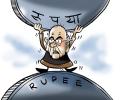
For the first eight months of the current financial year, the figure stood at Rs 7.17 trillion.

Gold prices this year are higher than last year, and the goods and services tax is an additional burden for consumers
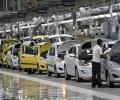
Data available from top six players - Maruti Suzuki, Hyundai, M&M, Tata Motors, Honda and Toyota - shows an average growth of about 42 per cent for the industry in June

The trio, 'twin shocks' of demonetisation and GST, 'twin balance sheet' problem that has been weakening India's banking system and the 'twin deficit' problem will continue to challenge economic management and performance in the year ahead, says Shankar Acharya.

Global cues lift Sensex 364 points; Nifty ends above 8,650.
The 50-share NSE Nifty slipped below the 10,200-mark by falling 47.20 points, or 0.46 per cent, at 10,192.95 after hovering between 10,169.85 and 10,296.55.
The chief statistician feels there should be a rebound after companies integrate and adopt the GST system
A normal monsoon, softer interest rates and inflation, pent-up demand, along with mild budgetary support may help growth pick up in coming quarters.

Of the seven surveys presented under Modi govt, predictions of three were quite close to the actual GDP growth rate, one saw the base year change in between, but the last three were way off the mark.

Some of the policy measures announced are expected to go a long way in removing current challenges on financing faced by businesses and also increasing economic activity, especially in areas of construction and manufacturing.
The deficit for the first five months of the year stood at 96 per cent of the full-year target of Rs 5.46 lakh crore despite cut in capital expenditure in August.
'When you need to revive the economy, when you need to revive aggregate demand, you cut taxes.' 'But what's this government doing?' 'It's increasing taxes for the middle class and the vast majority of the poor on fuel, which has a ratchet effect on most other products.'

The government has spent a little less than one-third of the Budget estimate of capital expenditure, it can still spend about Rs 20,000 crore this year without disturbing its fiscal deficit target.
Growth numbers for the large players in the sector, though, improved during the quarter.

Given the many policy areas where the Centre and the states have not been seeing eye to eye in the last few years, it is time the Modi government convenes a meeting of the Inter-State Council, recommends A K Bhattacharya.

'The question is, how soon we can expect to re-attain the pre-lockdown levels of output and income.'
Budget has already bombed at the box office and passing it without a revisit will be a mockery of the exercise though any modification may be short lived and perfunctory, observes V Ranganathan.

Senior Congress leader Shashi Tharoor on Tuesday attacked the Centre over the glitches in the new income tax portal, alleging that even after spending Rs 4,200 crore on it, the government had "failed" to make it user-friendly and created a "mess" instead.
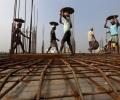
India can be rated as among the best performing economies in the world

City-wise data showed that there has been improvement in online recruitment activity. Kolkata (up 51 per cent) recorded the most notable annual growth rate among all monitored cities, followed by Baroda (up 46 per cent).
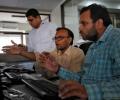
The broader NSE Nifty shuttled between 10,784.65 and 10,689.80, before ending 21.30 points, or 0.20 per cent, lower at 10,718.05.
Only one of the three drivers of the economy has performed in the way it should: government spending grew at 15.6 per cent, reports Abhishek Waghmare.
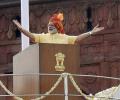
'You can accuse him of many things but one thing you cannot accuse him of is being bad at politics,' says Aakar Patel.

The economic activities that registered growth of over 6 per cent in the second quarter are manufacturing, electricity, gas, water supply, other utility services and trade, hotels, transport and communication, and services related to broadcasting.

India's economy recovered faster than expected in the September quarter as a pick-up in manufacturing helped GDP clock a lower contraction of 7.5 per cent and held out hopes for further improvement on better consumer demand. The gross domestic product (GDP) had contracted by a record 23.9 per cent in the first quarter of the 2020-21 fiscal (April 2020 to March 2021) as the coronavirus lockdown pummelled economic activity.

The surge in export, domestic demand and public spending in infrastructure projects might revive private investment during 2017-18.
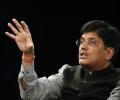
'Challenges will come but we will stay the course. No big step can be taken if one is afraid of criticism. We will not flinch from criticism,' says Railways Minister Piyush Goyal.
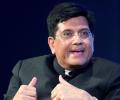
'A sum of Rs 6,000 a year is very significant for a small farmer whose land holding is very small and whose produce is very small. All these calculations on a daily basis are extremely unfortunate and an insult to farmers.'
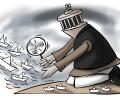
Export sectors that showed positive growth last month included chemical, iron ore, electronics, marine products and pharmaceuticals. Decline in overall imports, including oil and gold, led to narrowing of trade deficit.

Investor sentiment got a big push after Brent crude, the international benchmark, dropped below the $73-mark to quote at a seven-month low of $72.65

The NSE Nifty settled the day 96.80 points, or 0.94 per cent lower, at 10,224.95

The medical devices, which have been in high demand during the Covid-19 pandemic, will now see a drop in prices, as the earlier margins were up to 709 per cent for some of these products.

This is good news for the central government at a time when crude oil prices are rising.
Imports rose by 1.44 per cent to $43.44 billion in March 2019.

'The new government will have to contend with slowing economic growth, weak private investment, anaemic exports and vulnerable external imbalances, a stressed financial system, mounting fiscal pressures (including high government debt-to-GDP ratios) and an exceptionally bad employment situation,' says Shankar Acharya, former chief economic adviser to the Government of India.

In a paper, EAC-PM accused Subramanian of "cherry-picking high-frequency indicators" to express his skepticism about the growth rates after 2011-12.
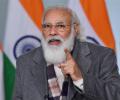
He is not good at thinking through laws and policies. His lockdown produced chaos and misery and didn't stop Covid. His GST finished off thousands of companies and reduced the amount of tax government collects to such an extent that he cannot pay state governments any more, observes Aakar Patel.

'We are in the reverse gear and we are not there anywhere compared to the rest of the world'

Market benchmarks Sensex and Nifty soared to new peaks on Tuesday, driven by gains mainly in metal, financial and IT stocks amid firm global cues and sustained foreign fund inflows. Tata Steel was the top gainer in the Sensex pack, surging 4.38 per cent, followed by Bharti Airtel 4.37 per cent, Vedanta 3.50 per cent, Tata Motors 3.03 per cent, HDFC 2.46 per cent and Bajaj Finance 2.39 per cent.After surging to its record intra-day peak of 41,401.65, the 30-share BSE barometer settled 413.45 points, or 1.01 per cent, higher at its all-time high of 41,352.17. Similarly, the broader NSE Nifty rallied 111.05 points, or 0.92 per cent, to its record closing high of 12,165.

The poll-panel called these seizures by its various field and technical enforcement teams a "historic milestone" achieved "for the first time in any assembly electoral process", meaning during simultaneously-held assembly polls.
